Showing posts with label death. Show all posts

Sunday, April 17, 2022

“If You Don’t Learn To Love Each Other, Things are Going To Get Much Worse!”


Valiant Thor and his gorgeous entourage


Russia is killing the Ukraine, and the spirits of the rest of us. 


How often do you find the Pope quoting you? Random remarks you spout off in the kitchen or bathroom while listening to “the horror and gore report,” otherwise known as “the news?” One of my personal rants at the news that only my family gets to hear - “I thought we were done with war.” All this business of soldiers and guns and bombs and weeping and bleeding. Then, I heard the Pope say so, recently, at the beginning of Lent, the time of purification before Easter, the resurrection of Jesus Christ - “I thought we were done with war.”


But, I’m paraphrasing - here is what the Pope actually said in his own, more eloquent, words -


“The truth is that ‘never has humanity had such power over itself, yet nothing ensures that it will be used wisely.’ We can no longer think of war as a solution, because its risks will probably always be greater than its supposed benefits. In view of this, it is very difficult nowadays to invoke the rational criteria elaborated in earlier centuries to speak of the possibility of a ‘just war.’ Never again war!”


“We are called to love everyone, without exception; at the same time, loving an oppressor does not mean allowing him to keep oppressing us, or letting him think that what he does is acceptable.” 


“On the contrary,” the pope said, “true love for an oppressor means seeking ways to make him cease his oppression; it means stripping him of a power that he does not know how to use, and that diminishes his own humanity and that of others. Forgiveness does not entail allowing oppressors to keep trampling on their own dignity and that of others, or letting criminals continue their wrongdoing.”


From Pope Francis to aliens - Yes, aliens have a stake in our survival as a planet and a species. 


First, aliens cannot write music. For music, they come to Earth. (That’s a joke. However, it could be true. We clearly have something they don’t; they have a vested interest in keeping earthlings well and functional.) Next, aliens harvest Earth’s force, usually leaving a crop circle behind as evidence. If humans were to disrupt the ki flow of Earth’s energy by nuclear annihilation, aliens might not be able to use the force. That’s a pretty simple breakdown of a process which most people have never heard of; even alien watchers have not figured out why aliens leave crop circles for us to decipher or why aliens come here at all, or if aliens are actually humans from the future. We do know that UFOs appear near nuclear power plants and nuclear weaponry. Warnings? What it all means is - Earth’s force must remain the same! We cannot destroy ourselves!


An over-simplification of Absolute Death. We are flirting with Absolute Death. I do not think our souls can survive nuclear war. If they are matter at all, physical in any way, then our souls will explode and dissipate.  


Elliot on the Red Phone


Mr. Robot, Season 2, Episode 1, final scene: An episode that was crammed full of hacker delights: bar codes to scan, Easter egg doors to open, and some choice low-tech hints that no one noticed. I was watching. This is what I saw: Eliot is in the front hallway of an old rooming house. There is a red phone on the wall. In these old rooming houses, a community phone was in the front hallway; no one had their own phone in their room. The red phone, any child of the Cold War will tell you, sat on the President’s desk and was a direct line to the Kremlin in Moscow, Russia, i.e. somewhere important in the world leader vein. The phone rings. Elliot picks it up and says, “Hello?” The voice asks, “Is it really you?” (Now we know Elliot is of extreme importance.) Elliot asks, “Who’s this?” The answer: “Thor. Valiant.” 


Fade to black. I’m shaking on the sofa. Who is getting this? No one. Obviously, someone in the writing department knows their shit. (I tried to comment and tell a writer of an Easter egg article about the low-tech stuff I knew, including the meaning of “red wheelbarrow” on Elliot’s composition notebook - from a poem by William Carlos Williams, about getting back to a simple life, but she fucking hacked the shit out of me to show her appreciation of my efforts. Lucky, I know a few things and I deleted her traps. As well as my comment on her article. Taking my ball and going home, fuck you very much.)


The Red Wheelbarrow

by

William Carlos Williams


so much depends

upon


a red wheel

barrow


glazed with rain

water


beside the white

chickens


Who was Valiant Thor?


Here is the unofficial story: 


A Visitor at the Pentagon

On March 16, 1957, a strange craft landed in a farmer’s field in Alexandria, Virginia. Local police arrived on the scene with guns drawn, expecting the worst. They were surprised to find what appeared to be an unarmed man stepping out of the craft. They were even more surprised when the man asked to speak with the President telepathically. It must have convinced them, so they immediately took him to the Pentagon. Over the next few days, the visitor would receive his meeting with the President and a fully furnished apartment deep within the Pentagon.


The Mission of Valiant Thor

According to Valiant Thor, he was sent here by a galactic council upholding the tenants of Jesus who was considered by Thor to be an intergalactic God, Savior of All Life Forms, to convince humanity to shy away from their use of nuclear weapons. Thor, and his group of alien assistants, all in the form of gorgeous human beings, hailed from the nearby planet of Venus. Thor convinced President Eisenhower to create a council against the use of nuclear weapons. However, the committee was repeatedly blocked by members of the CIA and DOD. 


Thor had to leave Earth defeated. His conclusion: Earth is more interested in making money than living in peace.


War and Reparation are BIG BUSINESS! Bigger than any other business. First, government contracts to kill, then government contracts to re-build. Until we break it, humanity is trapped by its leaders in this destructive and meaningless pattern. 


Remember, we always become friends again with our enemies - think Japan. The stupidest exchange ever had to be Hiroshima for Pearl Harbor. Isn’t it so much better to exchange sushi, sake, and technology instead of bombs, death and destruction?


Makes war obsolete.


I haven’t even touched on the constant African wars - the Congo, Nigeria - where men use more low tech weaponry, not any less deadly, to destroy. 


The Pope says we should not allow the oppressor to oppress us, but rather share some other options for him to achieve his goals. Negotiation. Talk. Friendship. There is no need to kill. No need to destroy. 


Or is it simply the desire to show the world one’s POWER? Who will be left to read history? Who will witness your power when the world is gone? Is there any power without a witness?


Virgin Mary
wearing her blue mantel of Peace


One more warning:


Came from Jesus's Mother, the Virgin Mary. Fatima, Portugal, 1917. Three young shepherds, LĂșcia Santos and her cousins Jacinta and Francisco Marto witnessed a vision of the Virgin Mary that spoke to them and gave them predictions of our fate. She showed the children a terrifying vision of hell.


“You have seen hell where the souls of poor sinners go. To save them, God wishes to establish in the world devotion to my Immaculate Heart. If what I say to you is done, many souls will be saved and there will be peace. The war is going to end: but if people do not cease offending God, a worse one will break out...When you see a night illumined by an unknown light, know that this is the great sign given you by God that he is about to punish the world for its crimes, by means of war, famine... (World War II) and persecutions of the Church and of the Holy Father. To prevent this, I shall come to ask for the Consecration of Russia to my Immaculate Heart, and the Communion of reparation on the First Saturdays. If my requests are heeded, Russia will be converted, and there will be peace; if not, she will spread her errors throughout the world, causing wars and persecutions of the Church. The good will be martyred; the Holy Father will have much to suffer; various nations will be annihilated. In the end, my Immaculate Heart will triumph. The Holy Father will consecrate Russia to me, and she shall be converted, and a period of peace will be granted to the world.” 


On 25 January 1938, The New York Times reported "Aurora Borealis Startles Europe; People Flee in Fear, Call Firemen." The celestial display was seen from Canada to Bermuda to Austria to Scotland, and short-wave radio transmissions were shut down for almost 12 hours in Canada.


As a result of the 2022 Russian invasion of Ukraine, Pope Francis announced he would consecrate Russia and Ukraine to the Immaculate Heart of Mary. It didn’t make the news. God has become a dirty word on network TV.


Jesus’s mother warned us: “If you don’t learn to love each other, things are going to get much worse!”


The blue of Mary’s mantel has always represented Peace. 


Let us take up that blue mantel for purely practical reasons.


Peace is Life.


Yes, they killed John Lennon, but they did not kill his message.


©Patricia Goodwin, 2022


Patricia Goodwin is the author of When Two Women Die, about Marblehead legends and true crime and its sequel, Dreamwater, about the Salem witch trials and the vicious 11-year-old pirate Ned Low. Holy Days is her third novel, about the sexual, psychological seduction of Gloria Wisher and her subsequent transformation. Her latest novel is Low Flying, about two women suffering psychologically abusive marriages who find and nurture each other. Her newest poetry books are Telling Time By Apples, And Other Poems About Life On The Remnants of Olde Humphrey Farme, illustrated by the author, and Java Love: Poems of a Coffeehouse.


Within this blog, Patricia writes often about non-fiction subjects that inspire or disturb her, hopefully informing and inspiring people to be happy, healthy and free.


Monday, January 18, 2021

Wormwood or How I was Poisoned by My Martini


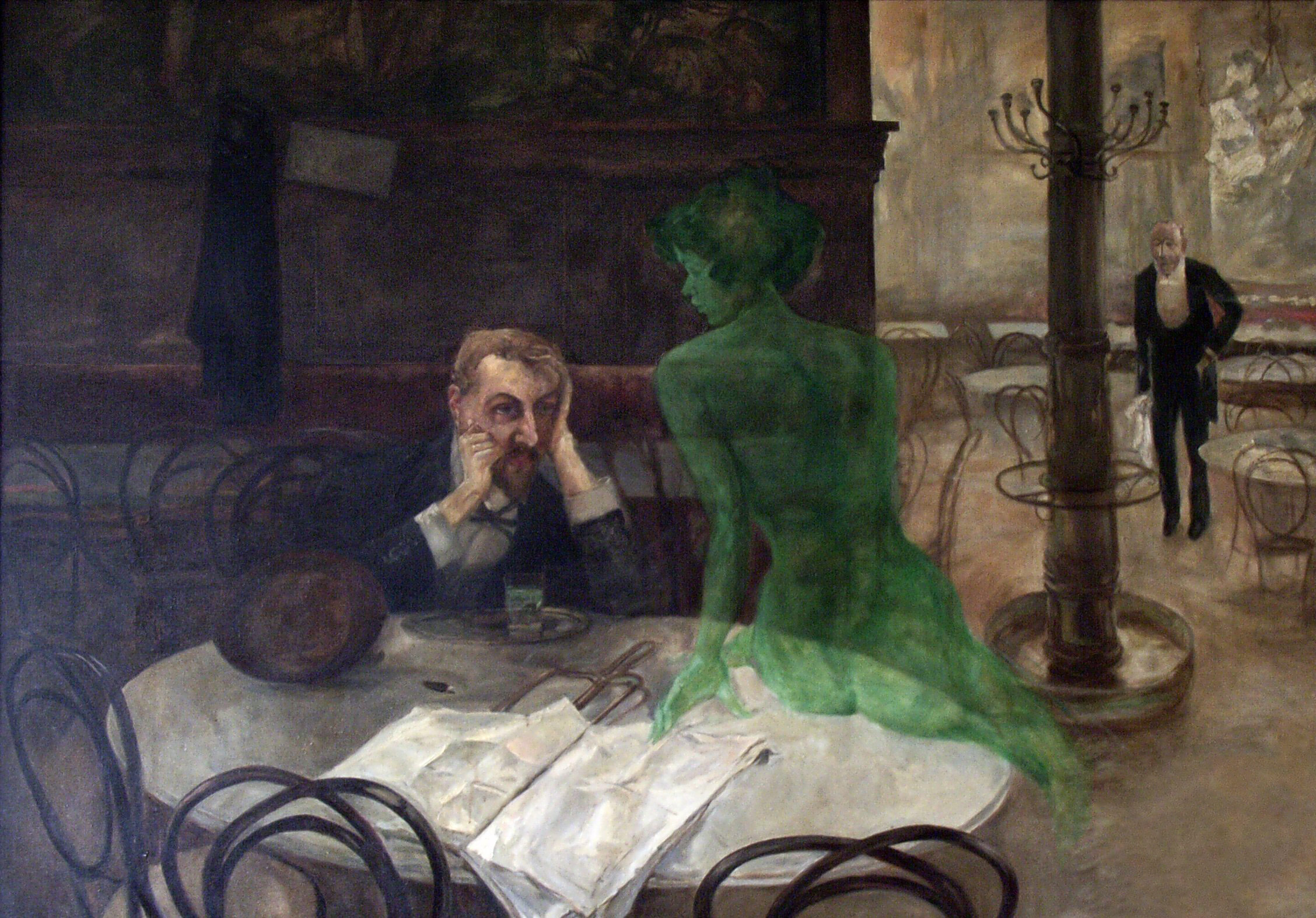
"The Absinthe Drinker" by Viktor Oliva, 1901, Prague


Wormwood. It sounds like a new western starring Brian Cranston. 


But, it’s the poison that poisoned me. Poisoned my already delicate nervous system. I remember when I had my consultation with Michio Kushi in 1975 - my husband had just been named Vice-President of the East West Foundation, a macrobiotic org, and I was asked to see Michio, our mentor and teacher, for a health consultation. I was ushered into the elegant, serious study in his old fashioned home. I sat down and faced him, a small, thin man in a dark suit and tie. He took one look at me and said, “No stimulants!” 


Outwardly, I nodded. Inwardly I thought, “Oh, dear. We’re going to have a problem.” As a writer I feared I would not want to live without coffee or wine!


If you read my blog post, Anxiety Now! You already know how I was poisoned. Martinis. A very sophisticated and elegant stimulant, loved by writers for decades. I used to have about two, maybe four a year, on special occasions, in equally elegant restaurants. But, since COVID, I’d been making my own at home. Two a night. (A doctoral thesis could be written about the comfort foods of COVID and their often terrible effects on human health!) 


Since two months of martinis, my husband, daughter and I noticed a huge increase in my anxiety that was making sleep impossible. Even when I wrote Anxiety Now! I hadn’t known exactly what had happened to me. Something kept nagging at me. Something, I thought, must be IN the martinis. What was it?


It had to be in the vermouth! I researched the mysterious, bitter, spicy vermouth, googling the ingredients - cinnamon, cardoman, ginger, cinchona, chamomile, and there it was - the same ingredient that had once been (and still was!) used to make the infamously poisonous absinthe that the French writers, poets and artists had taken to flirt with death and insanity - granted it was prepared differently - but, there it was - wormwood.


Wormwood, often called artemisia, whose side-effects are seizures, muscle breakdown (rhabdomyolysis), kidney failure, restlessness, difficulty sleeping, nightmares, vomiting, stomach cramps, dizziness, tremors, changes in heart rate, urine retention, thirst, numbness of arms and legs, paralysis, and death. 


As described on BBC Culture, “The spirit [absinthe] was a muse extraordinaire from 1859, when Édouard Manet’s The Absinthe Drinker shocked the annual Salon de Paris, to 1914, when Pablo Picasso created his painted bronze sculpture, The Glass of Absinthe. During the Belle Époque, the Green Fairy – nicknamed after its distinctive colour – was the drink of choice for so many writers and artists in Paris that five o’clock was known as the Green Hour, a happy hour when cafes filled with drinkers sitting with glasses of the verdant liquor. Absinthe solidified or destroyed friendships, and created visions and dream-like states that filtered into artistic work. It shaped Symbolism, Surrealism, Modernism, Impressionism, Post-Impressionism and Cubism. Dozens of artists took as their subjects absinthe drinkers and the ritual paraphernalia: a glass, slotted spoon, sugar cubes – sugar softened the bitter bite of cheaper brands – and fountains dripping cold water to dilute the liquor.


Absinthe was, at its conception, not unlike other medicinal herbal preparations (vermouth, the German word for wormwood, among them). Its licorice flavor derived from fennel and anise. But this was an aperitif capable of creating blackouts, pass-outs, hallucinations and bizarre behaviour. Contemporary analysis indicates that the chemical thujone in wormwood was present in such minute quantities in properly distilled absinthe as to cause little psychoactive effect. It’s more likely that the damage was done by severe alcohol poisoning from drinking twelve to twenty shots a day…”


As a student, we were told of raging artists running mad through the streets, and I confess to the urge to leap from the bed and run screaming through the house, something to the effect of “I don’t even waaaant to sleep!” But, I didn’t want to drag my family into my horror. I took comfort and still do in the fact that they were sound asleep. I was so glad it was me and not them.


The Chinese have a word for it - though it’s not exactly what I have, it’s close - they call the phenomenon, “Revenge Bedtime Procrastination” or the desire to delay bedtime while you enjoy the pleasures of light and daily activity. Something about control. But, add old age to the equation and you have the terror of death in which the darkness - which we need in order to make melatonin, that chemical that naturally closes our eyes and brings on the mystery of restful sleep - becomes death, particularly if you know you are in the last room of your life. It’s a beautiful room, but I must learn to embrace death. The movie “Dr. Strangelove or How I Learned to Stop Worrying and Love the Bomb” comes to mind. Even the cold assassin, Judberg in “The Edge of Darkness” feared the dark - “something about the dark,” he said. I’ve been using screen time, watching reassuring movies and shows that I have seen many, many times to lull me to sleep. I pause the scene and hold it there all night to comfort me that I am not alone. Screen time pollutes the eyes with light and tells your body to not go to sleep. I can’t help it. I need to see Carrie Bradshaw - she tries so hard - or Mary Spaulding - she’s so smart - or Olivia Benson - she’s so fearless - that they are with me - and then, I can close my eyes.


It’s a point of pride with me that Virginia Woolf was also diagnosed with a “no stimulants” delicate nervous system. She was a marvelous writer, whose prose was sheer poetry - deep, clever, courageous, profound, and beautiful. But, I don’t want to end like her. If you know her, you know that she saw “the shark fin on the horizon” and wanted to spare her family from further pain. However, though she wasn’t allowed alcohol, Virginia consumed copious amounts of stimulant in her daily tea. We all know that the English drink very strong tea and take it for everything from wet, cold feet after a walk to something to calm the nerves after trauma. Hmm. The shark is in the hen house.


I’m continuing my journey to freedom from wormwood. I tried Tylenol PM for nearly two months - it worked wonderfully! Till I got a few nasty side effects that I am still dealing with, mostly from dehydration; I couldn’t drink enough water! Now, I’m trying melatonin, which, after asking out on Facebook for help, I discovered most of my friends are already taking in 5mg to 10 mg form! I’m only using 1 mg and so far so good…like Steve McQueen says in “The Magnificent Seven” after telling the joke about the man who leapt off a four story roof; at each floor people heard him say, “So far so good!”


***Disclaimer: Patricia Goodwin does not blame or endorse vermouth. Many people may enjoy vermouth with no adverse effects. She wishes them bon appetite and bonne santé!


Patricia Goodwin is the author of When Two Women Die, about Marblehead legends and true crime and its sequel, Dreamwater, about the Salem witch trials and the vicious 11-year-old pirate Ned Low. Holy Days is her third novel, about the sexual, psychological seduction of Gloria Wisher and her subsequent transformation. Her latest novel is Low Flying, about two women suffering psychologically abusive marriages who find and nurture each other. Her newest poetry books are Telling Time By Apples, And Other Poems About Life On The Remnants of Olde Humphrey Farme, illustrated by the author, and Java Love: Poems of a Coffeehouse.


Within this blog, Patricia writes often about non-fiction subjects that inspire or disturb her, hopefully informing and inspiring people to be happy, healthy and free.


***Disclaimer: The information on this blog is not meant to substitute for medical care. Please consult your physician before beginning any new dietary guidelines. 

Saturday, December 21, 2019

The Godfather and Peaky Blinders: Why, Oh Why Did Apollonia and Grace Have To Die?


Michael Corleone and Apollonia 
on their wedding night


(Major Spoiler Alert!)

As I approach the computer I have the sensation that when I write this post, I will be playing music on the keys. Mozart, something gentle and soft, such are the emotions I feel toward these two characters that fate or writers or directors has decided to eliminate.

Apollonia, “More Greek than Italian!” The stunner in the film “The Godfather” who caught Michael Corleone’s eye and heart as the thunderbolt hit him while he was in hiding in Italy. The thunderbolt. So Italian to call it that, a misnomer because, really, the thunder roars and the lightning bolts. But, in Italian slang, it hits the mark. “You were hit with the thunderbolt!” cries one of his bodyguards. 

Michael and his bodyguards are walking in the hills. Here is the description of Apollonia as Puzo wrote it in the novel: “They [the girls] were dressed in cheap gaily printed frocks that clung to their bodies…Three or four of them started chasing one girl…The girl being chased held a bunch of huge purple grapes in her left hand and with her right hand was picking grapes off the cluster and throwing them at her pursuers. She had a crown of ringleted hair as purple-black as the grapes and her body seemed to be bursting out of its skin. Just short of the grove, she poised, startled, having caught the alien color of the men’s shirts. She stood there on her toes poised like a deer to run…Her skin was an exquisite dark creaminess and her eyes, enormous, dark violet or brown but dark with long heavy lashes…her mouth was rich…and dyed dark red with the juice of the grapes. She was so incredibly lovely that one of the bodyguards murmured, “Jesus Christ, take my soul, I’m dying.”

Puzo describes what Michael is feeling: “…he found himself standing, his heart pounding in his chest, he felt a little dizzy. The blood was surging through his body, through all the extremities and pounding against the tips of his fingers, the tips of his toes. All the perfumes of the island came rushing in on the wind, orange, lemon blossoms, grapes, flowers. It seemed as if his body had sprung away from him, out of himself. And then he heard the bodyguards laughing. ‘You got hit by the thunderbolt.’" 

When Michael and his bodyguards describe Apollonia to a local cafĂ© owner who happens to be her father, the man shouts, “No!” saying he does not know her. Michael immediately realizes he has insulted the father; he elegantly proposes marriage in the old way, saving the day. And unless you have been living on the moon, you know all this already and you also know that the old world courtship takes place so beautifully you want to die forgetting that in the old world not every groom was so handsome and fine and not every bride so happy. No matter! When Apollonia disrobes on her wedding night, we swoon. Her dark skin! Her breasts, so innocent and sweet! Michael! Into what unknown country have you ventured?

Here is how Puzo describes their wedding night: “Her flesh and hair, taut silk, now she was all eagerness, surging against him wildly in a virginal erotic frenzy. When he entered her, she gave a little gasp and was still for just a second and then in a powerful thrust of her pelvis, she locked her satiny leg around his hips…” We know from her lovemaking that Apollonia is more than a quiet virgin.

The next time we see Apollonia she is learning how to drive; she is chattering happily and waving her hands about explaining that now she knows everything, “Monday, Tuesday, Thursday, Saturday, Sunday!” Her long dark hair is up, in the old way, when a married woman no longer wore her hair down because a woman’s hair was considered flirtatious and now that she was married she should be more formal and refined.

We fall in love with Apollonia just as Michael did. In the throes of love comes despair. Apollonia is killed by a car bomb meant for Michael, even while we are laughing at the remark made by one of his bodyguards, “She’s gonna make a great American wife!” Even as we laugh at her cuteness at wanting to drive to Michael, as Michael softly smiles, then, as he sees one of the bodyguards sneaking off, he, realizing it’s a trap, screams, “Apollonia, no, no!” Disaster, horror, grief! How can this be?

But, we know. It was the author, Mario Puzo’s decision to kill Apollonia, when he wrote The Godfather. But, it is the director, Frances Ford Coppola, who explains in The Godfather Notebook, “Apollonia’s simple grace and overwhelming beauty MUST DOMINATE THIS WHOLE SECTION OF THE FILM. While she is alive, Michael can truly think of nothing else.” We surmise that Michael would have been too happy, too content with Apollonia, and he needed to be bitter, angry, hard for the work to come. His older brother, Sonny, has been assassinated in New York, making Michael’s return to the real world inevitable. Stylistically, Michael cannot continue to live in wedded bliss in Italy, in the old world, as though the new world and his new responsibilities did not exist.

Ah, me!

I am bereft. I want it both ways. I don’t see why Apollonia can’t fit into Michael’s new life in America. I still imagine the scenarios. Apollonia in New York. Apollonia shopping. Apollonia wearing her new clothes, sophisticated in her new hat. Apollonia pregnant. Apollonia cooking. Apollonia listening closely to the advice of her mother-in-law, seriously nodding her lovely head. Apollonia with children around her. All these scenes are still in my imagination. I even have imagined Apollonia’s reaction to Kay’s abortion, as though both stories could exist at the same time. I see Apollonia’s face stone cold and proud. She would never, never do such a thing. Never would she think it.

Sigh. I never liked Kay. 

At the end of the day, I miss Apollonia for all the wonderful scenes, comedies and dramas, she would have played. Yes, Michael would have had his hands even more full. Yes, our attention would have been drawn from the decidedly masculine action. Who am I to re-write The Godfather? I am the one who misses her. Perhaps we have to have tragedy before we can appreciate what remains - Mary Corleone. Michael’s beautiful, Madonna-like daughter. 

Oh, nope. Sorry, she also dies.


Grace Shelby

Now, Grace.

Grace, of the Netflix Original series, “Peaky Blinders,” about the Shelbys, a Birmingham, England family, charming Romany criminals led by the noble, intelligent, handsome Thomas Shelby. I’m a sucker for the noble thief. 

When we first see Grace - and her music is tinkling, trĂ©s gentile (“dreamy, ethereal,” as the captions call it) - she is walking toward Tommy Shelby’s bar The Garrison where she applies to be a barmaid. What looks like a gentle falling snow surrounds her as she approaches the bar. Suddenly, you realize, that’s not snow, it’s falling ash. This is Birmingham, England and Grace is the only light thing in the darkness.

Grace is a delicate blonde beauty with patrician lines. In fact, we learn Grace comes from a good family. She has joined the police force as an undercover agent to avenge the death of her policeman father by the IRA. Tommy’s not Irish. He is Romany, (aka Gypsy), an English criminal, a bookmaker, who happened on some brand new automatic weapons whilst robbing the BSA company warehouse. Finding these guns becomes the mission of the Crown and law enforcement.

Grace stands out. She wears no make-up, yet her large blue eyes are beautifully expressive. Her light hair is delicate, flowing around her face in soft, natural waves. She’s wearing a sheer white blouse and a soft green suit. The bar manager at first refuses her, saying she is “too nice.” “How do you know I’m nice?” Grace accuses him. She might not be nice.

She tells him she can sing, and she does, not in a sweet high voice you might expect from such a delicate form, but in a clear, bold alto. Riveting.


In fact, Tommy is struck (much like Michael Corelone) with the thunderbolt when he sees Grace for the first time. She obviously doesn’t fit. Unlike Michael, Tommy keeps his head. “Are you a whore?” he asks her, “because if you’re not, you’re in the wrong place.” Grace is hurt, but she perseveres.

Tommy doesn’t allow singing in the bar. He hates the Irish songs. But, he allows Grace to sing. He is feeling particularly down one evening. He tells her to sing. They are alone after hours in the bar. He tells her stand on a chair and sing. She stands on a chair. “Happy or sad?” she asks Tommy. “Sad,” he chooses.

As Grace sings beautifully, Tommy does something we know he can’t do - he falls asleep. We happen to know Tommy cannot sleep; he uses opium to sleep, to block out the night terrors of digging the tunnels in the mud of Flanders.

Grace remains standing silently on the chair.

Scene.

Grace doesn’t remain a barmaid for long. She quickly moves up to bookkeeper, making her privy to a lot of Shelby family business information. Grace falls in love with Tommy, but she betrays him anyway. Soon, she realizes where the guns are, and she reports this info to her superiors. After killing a few IRA guys, Grace becomes closer and closer to Tommy. Though she betrays him, she also protects him, hiding him in her room in a poor rooming house. The couple make love; they are in love. Tommy sleeps again, through the night. 

Grace writes to Tommy proposing a new life in America. Tommy writes back that he will consider her proposal. He says, “I learnt long ago to hate my enemies. But I’ve never loved one before. The idea of New York is interesting, but I have worked so hard for this day. For this victory. (Though Grace betrayed him, Tommy still won the fight.) I have responsibilities here. For people I need to protect and people who I love…I will give you my decision in three days.” He signs the letter, “All my Love, Thomas Shelby.”

Grace is already at the train station, where she must defend herself against her former boss who holds a gun to her head. :51 seconds to the end, Grace shoots her gun through her purse.

Scene.

I suppose it’s the same as Michael Corleone. Thomas has responsibilities. His way of life is extremely dangerous. We wouldn’t want Thomas to become too soft or too happy. But, unlike Apollonia, Grace is trained in warfare. It was and still is hard for me to suffer that the day they return from their honeymoon, Grace dies from a bullet meant for Tommy. She would have been sooo much fun to watch develop as a character, she might have even stolen the show from Tommy.

I wonder, too, as I watch, how deep does this phenomenon go? I mean, Apollonia, Grace, Mary Corleone, these are the things we fight for, die for: home, hearth, love, family, all the good and beautiful things in life. These we fight to protect. Yet, these are the sacrifices. Are the stories saying, in effect, I guess we can't have nice things? Someone, or some force, is always trying to take them from us.

Peaky Blinders is not the same without Grace. All the other blondes on the show are brassy, fakey, creepy, angry, stupid. They’re just not Grace. They don’t have her natural, well - grace. Not her intelligence. Her stature. Her poetry. Her way with Tommy. Grace goes deep.

I couldn’t bear to watch the new season. Season 5. It took me a long time to come around, but when I did, what a lovely surprise! 

Grace. Tommy talks to Grace. He sees her. She speaks back. “Happy or sad?” she asks. And she holds Tommy’s weary head to her breast. Tommy has a death wish. Twice, we see him struggle with the urge to harm himself. Then, after a colleague is killed by a car bomb, Tommy hesitates to start his car. Grace is in the backseat. “Push the button, Tommy. Come home to me,” Grace says. Tommy pushes the button. The car starts up safely and Grace disappears again.

At the end of Season 5, we have what people are calling “a strange ending.” This is the third time Tommy expresses his death wish. He is unable to stop a fascist movement in England. He has said he would stop when he met the man he couldn’t defeat. The screen goes X-Files blue. Tommy and Arthur are at home, in front of their house, with Arthur trying to console Tommy about the events gone wrong, “Let’s go inside. We’ll work it out. Have a drink.” “I need to walk.” Tommy sets off into the blue fog over the field where the landmines had been; he sees Grace, there is a dark horse, as in the Jew’s dream. Grace says, “The work’s all done, Tommy. It’s all done. We can walk away from all of this. It’s so easy. It’s so soft. Such a small change.” 


Tommy puts his gun to his head and screams. 

Scene.


Epilogue:

Spoiler Peaky Blinders - There will be a Season 6 and 7 - Cillian Murphy (Tommy Shelby) has already signed on. After all, we didn't hear a gun shot.

Two things I learned about The Godfather while researching this post - 1. Michael and Apollonia lived in Italy for months before she was killed. When Apollonia died, she was pregnant. 2. The guilty bodyguard disappeared after the bombing, but many years later, Michael tracks him down to a pizza parlor in Buffalo where a Corleone soldier kills him with, “Michael Corleone sends his regards.”


©Patricia Goodwin, 2019

Patricia Goodwin is the author of When Two Women Die, about Marblehead legends and true crime and its sequel, Dreamwater, about the Salem witch trials and the vicious 11-year-old pirate Ned Low. Holy Days is her third novel, about the sexual, psychological seduction of Gloria Wisher and her subsequent transformation. Her newest poetry books are Telling Time By Apples, And Other Poems About Life On The Remnants of Olde Humphrey Farme, illustrated by the author, and Java Love: Poems of a Coffeehouse.