Marcel Proust
Picture a cozy domestic scene: years ago,
my daughter is in high school, in Advanced Literature, she’s doing her
homework; I am vacuuming her room. I see a copy of Oscar Wilde’s short
stories on her desk. I pick it up, vacuum still going, and open to my favorite
line in Salomé, “Suffer me to kiss thy lips!” Salomé whispers this to the
captive John the Baptist. Think of it! To be kissed by Salomé, John would suffer! “Suffer” is an old term, used as an equivalent of "may I please," but in this case,
the virtuous John would indeed suffer. Exquisite line. Think of it! Wilde paid
dearly for each and every word: he lived for them; he went to prison for them; he
died for them. He ate, drank and sweated his words. And they are perfect.
I searched the pages, ah! Found the
passage! I read: “Let me kiss you!”
What? Desolation! A sinking in the pit of
my stomach, but, no matter, I have my own copy of Salomé.
“This is a terrible translation!” I scold
my daughter, tossing the book on her desk.
I vacuum a few inches. I stop. That was
no translation! Wilde was English! That was a dumbing-down of literature! “Sacre
Bleu, Invaders!”
Twenty years before that afternoon,
another afternoon: I am entering my English class at college, a course on the writer, Henry James. The
day is dark, so dark, in fact, the lights are on inside and you cannot see out
the windows. The world appears as dark as night; the campus lights are burning. No
one is in the room except my tall and awkward friend, Douglas (When we walk
together, he says we are both freaks because he is too tall, way over 6 feet,
and I am too short, barely 5). Douglas has a stutter, yet he is the most
eloquent person I know.
“Listen to this,” Douglas tells me and I
do. He reads from his book. Not James. “A
little tap at the window, as though some missile had struck it, followed by a
plentiful, falling sound, as light, though, as if a shower of sand were being
sprinkled from a window overhead; then the fall spread, took on an order, a
rhythm, became liquid, loud, drumming, musical, innumerable, universal. It was
the rain.”
This last sentence, he delivered by
turning toward me, as if to emphasize it, because it was raining then on that
dark day, sheets of it pouring down the black windows. He hadn’t stuttered
once.
“It’s P-P-P-Proust,” Douglas told me.
I nodded, silently, in awe. I decided in
that perfect moment that I should not read Proust until I was much, much older.
And, I haven’t. Till now. The time has
come. I’m 66 years old and I can devote my attention to his words. I’m retired.
My child is grown, I have no pets, just a pesky husband who always wants to
know what I’m writing – kidding – he doesn’t. He’s just as happy to listen to
the news or do nothing at all – it’s an art – he’s retired too.
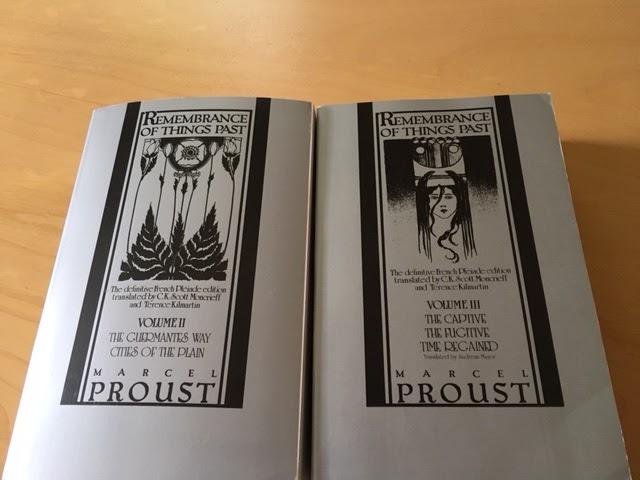
So, I dig out my old copy of Remembrance
of Things Past, Volume I, Swann’s Way, Translated by C.K. Scott Moncrieff. I
paid $1.95 for this quality paperback at the Cambridge Paperback Booksmith in
1973. (If only I had purchased Vols. II and III as well! If I’d known then what
I know now!) Forty-five years later, the book is pretty moldy. There are roach
poop stains on some of the pages from the years we lived in a studio walk-up on
Charles Street in Boston. (I loved that studio – traditional architecture,
fireplace, huge windows looking out on to a wisteria-filled alley - till the
roaches took over and the window caved in.) The book is brittle. The pages are
dark yellow. The print is tiny. I look online for a replacement only to fall in
love with the cover on the new Modern Library edition – an unmade bed – oh,
that’s cool! A brand new book! Exciting! Plus, I can see there are 6 more
volumes! The last 3 were only recently published. I order the first one just in
case I cave. It will be a major project; I’m not sure I can finish all 7
volumes.
The new book arrives and I have it by my
bed for a while, I admit. Right on top of A
Vindication of the Rights of Woman by Mary Wollstonecraft. Yeah, I’m a
nerd.
After I finished the book I was reading –
unremarkable, so I won’t say what it was – I announce to my husband and
daughter that I’m finally going to read all of Proust! I’m so excited.
I begin with the new edition. Wait, the
title is different? It’s not Remembrance of Things Past. It’s In Search of
Lost Time. Wow, that’s a big difference. I know Proust is successfully remembering.
I have dipped into it a few times, out of complete adoration, and read, if I’m
honest, the same 23 pages over and over. He’s not exactly “searching for lost
time” - even though he claims to be in the narrative.
I also remember, from my research, that
Proust approved this title, which comes from Shakespeare – I'm posting the entire sonnet, which almost seems to reflect the 7 volumes from Swann's Way to Time Regained.
"Remembrance of things past" –
Sonnet 30
When to the sessions of sweet silent
thought
I summon up remembrance of things past,
I sigh the lack of many a thing I sought,
And with old woes new wail my dear time’s waste.
Then can I drown an eye, unus’d to flow,
For precious friends hid in death’s dateless night,
And weep afresh love’s long since cancell’d woe,
And moan th’ expense of many a vanish’d sight.
Then can I grieve at grievances foregone,
And heavily from woe to woe tell o’er
The sad account of fore-bemoaned moan,
Which I new pay as if not paid before.
But if the while I think on thee, dear friend,
All losses are restor’d, and sorrows end.
I’m baffled by the new title to the books, and I
recall being baffled when I was first taught the word “rechercher” by Miss
Petite, my French teacher in high school. She said it literally meant “to
search for” but that the French use it to mean what we call “remember.” Ah, the
French, so passionate! I check the translator. Now there is a new name: Revised
by D.J. Enright. Already, I don’t like D.J. I mistrust him.
I begin reading anyway.
I notice there’s no Overture. The book
goes right into Combray. I check my narly old edition. Hmm. The words seem to
be the same. I read some more. I stop at the phrase, “soft as cheeks of
childhood.” No, no, no. That’s wrong, I can feel it!
Out comes the old book again: “cheeks of
babyhood.” Yes! Much more like it. The cheeks of 5-year-old child have already
begun to toughen from the bumps and bruises of the playground. A baby’s cheeks
are the most miraculously tender flesh on earth.
I read on, thinking, feeling, really,
“This is clunky. Where is the sweet, flowing prose I experienced in Remembrance
of Proust Past?”
I am reminded of the empty, sinking
feeling I had biting into Go Set A
Watchman when I was not greeted by the voluptuous, Southern cadence of To Kill A Mockingbird!
I put down the clean, new D.J. edition to
brave the fungus and mold of my old copy. I stop at the phrase, “I would ask
myself what o’clock it could be...” Oh, yes! Lovely! Just for kicks, I check
the new edition. “I would ask myself what time it could be…” Blah! That kind of
bull merde I can get anywhere is NOT why I want to read Proust! Reminds me of
Woody Allen telling the actors to just say whatever pops into their heads. No!
I don’t want Scarlett’s wit when I anticipate Woody Allen’s, thank you very
much!
Now begins my search for In Search of
Lost Time. I begin researching translations. I never thought I would be in this
position. As a student, I thought, oh, great, it’s in English! I wondered why
anyone would complain about what seemed trivialities then. Now, I understand. I
look online for old books, used books on Amazon or anywhere. Most of them have
what are called “highlights,” those yellow marker study lines over the text
made by earnest students. No, thanks, no highlights. I didn’t do that when I
was a student, why would I want that now?
I find a two volume set, send for it, and
when it arrives from Oregon, I discover, well, I expected the print to be tiny,
it’s all 7 volumes, after all, but I had hoped against hope that it wouldn’t be
too damaged by the ravages of time. Given to P.L. at Christmas, 1941. You can
smell the mold. My own book isn’t this bad. I place the 2 volume set by my
bedroom hearth, unable to throw them away just yet.
My two volume set has the name, Frederick
Blossom as well as Moncrieff. Hmm. A brief check of certain key words I love
leads me to find that this helpmate is more loyal to Moncrieff than D.J.
Enright. In my online searches, I found mention of a Lydia Davis, who,
apparently, began her translation by going slowly line-by-line. Oh, no! I
wonder where does a translator draw the literal line? Especially with the
romance languages! They are so passionate, not to be taken literally!
By now, I am thinking it might be easier
to learn French.
I’m curious. What do the French read?
I Google “Swann in French.” Do the French
see M. Cygne when they open their copy of Proust? Amazingly, non! They see “Du
Côté de Chez Swann!” There’s even a nice French lady who says, “Swann! Swann!”
with a smooth French accent.
I wonder he didn’t translate Swann’s Way
as “The Coast of the House of Swann.” Or offer the title, In
the Shadow of Young Girls in Flower instead
of Moncrieff’s more subtle, and I think, more French, In a Budding Grove.
I’m amazed that D.J. didn’t break open the
word, Guermantes ( a riverside path) into “Hardly a Mantle!” I would hate to
think what D.J. would do with Baise-Moi by French author, Virginie Despentes.
The rated PG version, Kiss Me?
I read my old book for about a week
before my right hand broke out in a rash. My eyes got itchy. I broke out in
hives.
Alas, I had to put it aside and reach for the new
one. I decided, if D.J. had kept a certain word, the word “houri,” I would read his edited translation. He had. He’d kept Moncrieff’s line exactly the
same, in a description of white or purple lilacs, a flower that hangs in
bunches like grapes: The nymphs of spring
would seem coarse and vulgar in comparison with these young houris, who
retained, in this French garden, the pure and vivid coloring of a Persian
miniature. I look up the words, houris, and find that the word means a pure
woman of Muslim paradise, but, more precisely, that the whites of the woman’s
eyes are pristinely white. Very interesting to me, as a macro, because, if the
whites of the eye are purely white, then that person is extremely healthy. I
trembled once again with adoration of Proust.
I crossed over to the new world. The one
in which educators have decided that students are too stupid to understand the
original intention of the author. There’s even an annoying introduction by a
Richard Howard, who teaches literature at Columbia, which begins, “Dear Proust,
meet your new readers…your reputation as a difficult author is widespread, and
many readers are daunted.” Daunt, no more, dear readers! In 1992, Modern Library
actually announced these volumes as the “definitive translation” of Proust’s
masterwork. Definitive because it’s the only translation now available without
mold!
I don’t think the students are too stupid.
I think it is the teachers who are too lazy or too stupid to teach the novels
that were written so eloquently and finely, and bravely by writers who are no
longer around to defend their work. Shakespeare is hard to read, but no one
fucks with his words. I used to feel sorry for friends who knew Greek or Latin
and had to read altered versions of the classical Greek plays or altered
versions of the Bible or, in a more modern context, altered James Joyce’s Ulysses. I think of the scholars who
could recite long passages of ancient poetry. Recitation was a huge part of
learning in the old days, and a fond way of remembering one’s youthful study. People
used to recite at parties to entertain one another. Does everything fine need
to crumble and die?
I could spend the rest of my life comparing
new editions of my favorite novels. But, I won’t. I will keep my moldy old
books because I want to keep the precious, vibrant, stunning words I fell in
love with in the first place. Until I crumble and die.
Proust doesn’t really have chapter
endings the way most books do, but, as I read, I sensed the section was coming
to an end and after weeks of reading, I wasn’t ready for it. I didn’t realize
that I was approaching the end of Combray, the section about the summer home of
his youth, the countryside, the gardens, the food, told through the dear and honest
impressions of a child. Next, is Swann in Love. Do I really care about the morés
of early 20th Century French salon society? No, but I do care about
M. Swann. So, onward!
I last for nearly 50 more pages of D.J.
before I feel cheated again. I can just feel the prose is not good. I’m not
enjoying myself. I’m not moved. In fact, I’m confused about what’s going on in
the drawing room of the Verdurins. I return to my Moncrief for answers.
Comparing only one page delivers the meaning I’ve been looking for – poor M. Saniette
is morose, not dull, about his continuing faux pas in society. Morose is the
French word for morose! Mon Dieu! Idiot! Now I understand what is going on with
M. Saniette, who suddenly seems so sweet and charming. Further down the page, I
find the description of a young lady as “having her wits about her.” But, Moncrieff
has described her as “having the American eye!” I literally bang the D.J. book
with my fist. Pow! Pow! Pow! You little shit! I could write pages about how
“Americans are very appreciated” (The
Portrait of a Lady, Henry James) in Europe where the impoverished aristocracy
like to infuse the Americans’ hot, new blood into their own cold and mildewy. I
could go on about the brave American spirit, about fresh American youth! One word, so full of connotation!
I’m forced by my love of good writing, my
love of Proust, my dream to read him, finally, in my old age, to return to my
old Moncrieff and risk poisoning by mold and mildew. Like an old French
aristocrat, like Rapacinni’s daughter, I shall be poisoned a little at a time, by
beauty, until I cannot leave the house or garden for fear of passing on.
It’s fitting that I am reading
Remembrance of Things Past now that I am old and
remembering and searching, as always, for knowledge. But, that is the faith.
That is the covenant of the artist with time, with those who come after. I
believe in the artists. I love them, and their art.
I refuse to let them die.
UPDATE: I finished the first volume Swann's Way today! I had given myself reading time during breakfast and lunch, so it did take a while. I realized that I did not possess the second volume, Within A Budding Grove, but I was able to purchase that book today. Thanks to the original publisher, Chatto and Windus, and the renegade Random House (which randomly published the new rogue Modern Library editions), there are also available on Amazon, fresh new books (I had to dig to find them) of the C.K. Moncrieff translation, thank you, thank you, God! (I'm going to read Baise-Moi while I wait.)
**Update: I read Baise-Moi: it was brilliant and disturbing. I went on to read other modern books, needing to get out of the 19th Century, a contrived and artificial place where I am never comfortable. After a few diversions, I picked up The World Broke in Two: Virginia Woolf, T.S. Eliot, D.H. Lawrence, E.M. Forster and the Year (1922) That Changed Literature by Bill Goldstein. I couldn't help wondering how the author could broach such a subject without considering James Joyce's Ulysses and Marcel Proust's Remembrance of Things Past. He didn't. In fact, the whole book is about the effect of Ulysses and Remembrance, on the future of literature, on the writing style of these authors in particular, authors who had desired a new way of telling their stories. The effect of Joyce and Proust had been liberation. Shall I tell you what was said about Proust? Virginia Woolf said it best: "in a state of amazement; as if a miracle were being done before my eyes…How, at last, has someone solidified what has always escaped - and made it too into this beautiful and perfectly enduring substance? One has to put the book down and gasp. The pleasure becomes physical - like sun and wine and grapes and perfect serenity and intense vitality combined…Well, what remains to be written after that?"
Well, Mrs. Dalloway, To the Lighthouse, The Waves, The Wasteland, A Passage to India, Lady Chatterley's Lover.
And, this from the elite C.K. Moncrieff translation, from folks who could read French.
©Patricia Goodwin, 2018