Friday, January 29, 2021

HOLY DAYS: Bettina and Susie

 Lately, I've been finding a lot of strength looking at family photos. Here is a photo taken in 1957 of my mother, her beautiful red hair in pin curls, my great aunt and her movie star pretty girlfriend. They seem to be looking at a family photo album - fitting. My aunt and her girlfriend were brave. My mother welcomed them; no one else in the family would receive them. They came to do my mother's hair and insisted on having a reason to come when my mother would say, "Oh, just come over!"

Here is a chapter from my novel, Holy Days inspired by my Great Aunt Bettina and her love, Susie.


REVERE, 196-

BETTINA AND SUSIE


“In the home,” Daddy was saying, his voice cracked with sobs, “they never let us...”

“Take it easy, Billy,” consoled my mother’s Aunt Bettina, with her deep voice,  “that’s all over now. You got a nice family now and a nice home. You made it out of there. Right?” 

With her own strong grip, she held his trembling hand across the kitchen table. He didn’t often do that, break down about the home in which he had spent much of his childhood, but, occasionally, if the conversation hit a nerve, he crumbled.

They’d been talking about me reading at the dinner table, how I always had a book and whether or not it was a good thing. Daddy broke down because the priests wouldn’t let them read books. If they were caught doing nothing, as the priests called it, they’d be given work to do, like scrubbing the toilets or the long staircase in the rectory.

Aunt Bettina had a voice as deep and gruff as a man’s could be. She fooled me every time she called on the phone. 

“Rosie, there?” she asked in the playful tone of a man, who was strange to me, but who seemed to know Ma secretly and very well.

My back went up like a little porcupine. Who was this guy who thought he could talk to my mother like he was her boyfriend? Annoyed, I handed Ma the receiver.

“It’s a man,” I said, disapprovingly.

She looked quizzical. Her insurance broker? A salesman?

I could hear the male voice laughing, deep and loving, echoing along the little space between Ma’s ear and mine.

“It’s a man, Rosie! It’s a man!” Aunt Bettina teased.

Ma laughed, looking my way and shaking her head.

“It’s your Aunt Betty, you stupid,” she said, affectionately.

We were supposed to call her Auntie Betty, but I couldn’t resist calling her Aunt Bettina, which was a much prettier name. She was a small woman who wore her thick brown hair short and combed straight back from her noble forehead. She smoked more cigarettes than Daddy. When she visited Ma, she drank Lipton tea, but I always envisioned a heavy set glass of whiskey rather than Ma’s crockery mug with the tea bag’s tiny string and label dangling out that seemed so fragile in front of her square body. Aunt Bettina was Grandma’s sister, but our family was the only one who would receive her.

She came, always, with her girlfriend, Susie, who called her Tina, in a secret pet way, which was lovely to hear. Susie had pressed gold hair that she wore in the style of the glamorous movie stars of the Thirties, like Carroll Lombard or Betty Davis, in permanent waves cascading close to her skull. She held her neat, golden head very erect upon her tall, thin frame, like a ballet dancer. 

Bettina and Susie had to have a purpose for coming, usually to do something for Ma. Maybe, that was their way of rationalizing this risk to Ma’s standing in the family. I had no idea why Aunt Bettina wasn’t welcome at Grandma’s house, Grandma, who was the most generous person I knew, but the only thing wrong with her was her voice and her hair, so, I assumed, whatever these were clues of, that was the reason. This “reason” floated above Bettina and Susie like - curiously enough - halos, since it seemed to single them out for a perverse kind of sainthood.

In fact, there was something uncannily sweet and fine about Bettina and Susie. Bettina and Susie. Why do some of the names of our pasts ring out like the bells of heaven? And others like the tolls of hell? Bettina and Susie, two saints, two angels kicked out of the church, but, I was sure, not out of heaven.

On this night, Susie stood and retouched Ma’s hair with Blondex while everyone talked. I was reading Dickens, “real reading,” not for school. I always read every book the author had written, not just what I had to read for school. “Real reading” became like a song for me.

Ma sat without her glasses, her beautiful eyes puffy from the shampoo, a towel spread over her shoulders, the squirmy terrier in her lap. Susie called Tareyton, “La Pishashta,” in bastardized Italian, the little pisser. Ma handed Susie bobby-pins as Susie sectioned the wet, dark red hair, spun the ribbons of hair on her finger and pinned them in little circles against Ma’s head, till Ma’s hair disappeared and she was wearing a bathing cap of tight red spirals. Daddy sat with us, which was a phenomenon, a tribute to Aunt Bettina, really. He kept trying to give her “a little shot” with her tea.

They were asking me about the tiny print and the thin pages in my book.

“Look at the pages! So thin! Like the Bible! How the hell kin you see those words, Gloria? You’re going to ruin your eyes! Billy, you should get her a magnifying glass, no shit.”

Daddy laughed, kind of proud of me, “Ah, she loves that stuff! The smaller the print, the thinner the paper, the better! What’s that? Shakespeare?”

“Dickens.”

I called all the books by their authors now, no matter what the title, they were Dickens or Stewart or du Maurier.

“Oh!” he said, like he knew.

“She should be a teacher,” Aunt Bettina advised.

Susie agreed. She nodded, bobby pins jammed in her mouth.

“I’m going to be a writer,” I said.

“Mmmm!” Susie murmured, impressed.

“A what? What, like for a newspaper?” Aunt Bettina growled.

“No, like for books.”

“That’s no good! Be a teacher! You get your summers off.”

Everyone agreed, I could travel, they said. I’d get paid for my summers and have them off too. 

“She’s always reading,” Ma told them. 

“Oh, yeah? You should be a teacher, then.”

“She even brings a book to the table. I have to tell her every night, no reading at the table,” Ma said, proudly, handing Susie another bobby pin for her mouth. 

“Oh, that’s no good. You shouldn’t read at the table,” Aunt Bettina told me.

“I can’t stop,” I said. 

That’s when we noticed Daddy’s eyes had gone all red and the tears started to drop, one by one, on the table. He sniffed and Aunt Bettina asked him what was wrong.

He told us about the orphanage. Things leaked out, from time to time, about his past, things leaked, just like his tears, one by one and fell before us. I still don’t know everything I should about my father’s life, all the mysteries, all the reasons. But, I couldn’t stand to see him cry. My stomach hurt, as though someone powerful had grabbed it full in his fist and twisted it mercilessly. Tears gathered in my own eyes, Susie looked pained and Ma looked down at the pins held tightly in her red-tipped fingers. 

“I keep having this dream,” I said, quietly.

They all looked at me.

“What? Like Martin Luther King?” Aunt Bettina joked uncomfortably, trying to break the tension.

I smiled. “Kind of. The Communists come marching down the street. Right down Hichborn, with tanks and soldiers doing that step - what is it?”

“The goosestep,” Daddy sniffs.

“Yeah, the goosestep. I can see them and hear their feet coming right down our street where we use to play and I’m terrified. Next thing I know, they’re storming up the steps to my room; they make so much noise it scares me to death. They have guns with bayonets and big boots and helmets, like the Nazis. I keep getting them mixed up with the Nazis. They start tearing the books off my shelves and they’re going to arrest me and take the books away and burn them. It’s funny, one of the books they take is The Diary of Anne Frank. And in my dream, I walk right up to the leader, the sargeant, or whatever he is, and I say, “You can’t take them from me. I’ve already read them.”

They were silent a minute, then Aunt Bettina said, “You should come down and talk more often, Gloria.”

It was true. I never came down from my room. I’d created another world up there with my books and my heroes. But, I’d made a special effort this night because Bettina and Susie had brought me clothes. Beautiful clothes. Aunt Bettina’s old cashmere sweaters that had a faint odor and coating of dry cleaning which clung to my hands like a film of oldness after touching the soft cushy fabric, but I didn’t mind; the colors were deep browns and greens, the colors of the forest at night and no one had ever given me anything so fine. There was also a fuchsia wool jacket of impeccable tailoring, not that I would have known what such a thing as impeccable tailoring was, I just knew it when I saw it. The jacket had short sleeves and I marveled that a woman could be cool enough to need a jacket, but warm enough to not need sleeves.

It was then that Jakey walked in the back door with Rick right behind him. 

“Where you comin’ from?” Daddy asked Jakey.

Jakey shrugged, “Nowheres.”

Aunt Bettina studied them both. Susie went on with Ma’s hair as though she had no need to study them, she already knew what she’d find. 

“Clean your feet!” Ma hollered, after they were on their way upstairs.

As he passed me, Rick mumbled, “Body by Fisher” and Daddy’s head jerked round in my direction.

“What did he say?”

“I don’t know,” I lied. It was from a car commercial, something about the sleek body lines of the car. Earl Rizzo had started calling me that.

“He’s a little scumbag, huh?” Aunt Bettina asked Daddy.

Daddy polished off the dregs of his beer.

“You said it!” he agreed.

“What the hell happened to his face?” she asked.

There was an awkward silence for a minute while we waited for each other to answer her. 

“He was hit by a truck when he was little,” I said.

“Jesus!”

“Want some more tea, Betty?” Ma asked her.

“Sure, Rosie.”

“Kin I interest ya in a wee drop o’ the creacha’, Betty?” Daddy teased with a mock Irish brogue.

It was amazing how quickly and how often my loyalties shifted. How war wasn’t as simple as it should be - it was more like the stories people tell afterwards, as when a prisoner actually has to live with his enemy and the enemy takes care of him, nurses him back to health, and, finally, hides him from his own side and helps him to escape. There was never a time when I could forget, never a time when I could believe that Daddy was my father. At times, he was the enemy and I was his prisoner, and at other times, I was caring for him and hiding him, sorry we were enemies. Never did I plan his escape. No, in fact, I was sure I should kill him. If I were honorable and brave, I would have killed him by now. No hero would have eaten his food or drunk with him at his table. I should have run him through with my sword a long time ago. That much was clear.

What was not clear was why his tears cut through me like a sword. Why it made me proud sometimes to think of him. Why it repulsed me right now to watch him getting another drink, and absentmindedly scratching one foot with the rough, peeling skin of the other. Why I let Rick talk to me like that. Why I was proud to have him think I had a Body by Fisher. Why I was proud that he’d been hit by a truck and was so tough he was still walking around. I should kill them both. I should kill them. Why didn’t I? Why?


©Patricia Goodwin, 2015


Patricia Goodwin is the author of When Two Women Die, about Marblehead legends and true crime and its sequel, Dreamwater, about the Salem witch trials and the vicious 11-year-old pirate Ned Low. Holy Days is her third novel, about the sexual, psychological seduction of Gloria Wisher and her subsequent transformation. Her latest novel is Low Flying, about two women suffering psychologically abusive marriages who find and nurture each other. Her newest poetry books are Telling Time By Apples, And Other Poems About Life On The Remnants of Olde Humphrey Farme, illustrated by the author, and Java Love: Poems of a Coffeehouse.


Within this blog, Patricia writes often about non-fiction subjects that inspire or disturb her, hopefully informing and inspiring people to be happy, healthy and free.

Monday, January 18, 2021

Wormwood or How I was Poisoned by My Martini


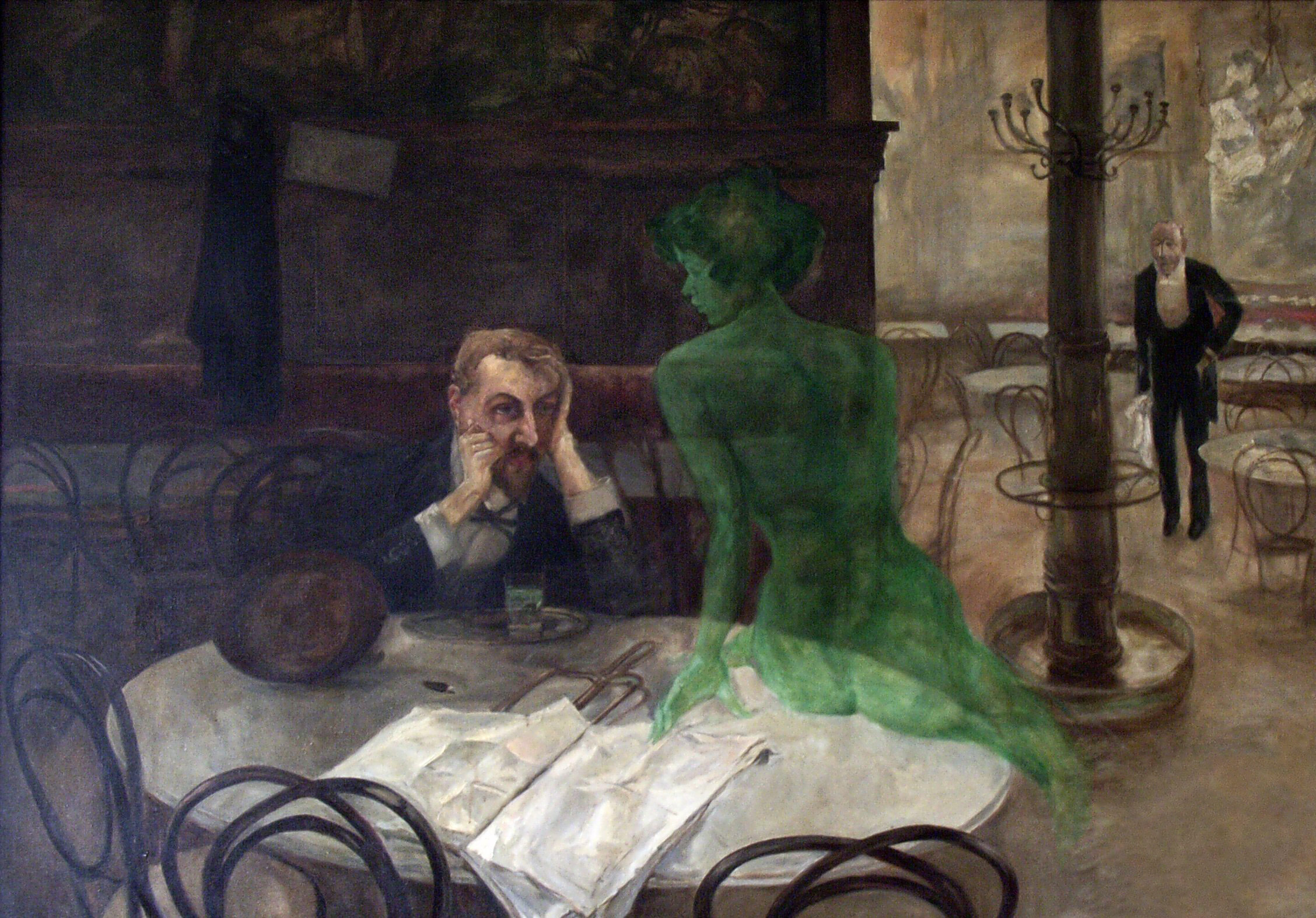
"The Absinthe Drinker" by Viktor Oliva, 1901, Prague


Wormwood. It sounds like a new western starring Brian Cranston. 


But, it’s the poison that poisoned me. Poisoned my already delicate nervous system. I remember when I had my consultation with Michio Kushi in 1975 - my husband had just been named Vice-President of the East West Foundation, a macrobiotic org, and I was asked to see Michio, our mentor and teacher, for a health consultation. I was ushered into the elegant, serious study in his old fashioned home. I sat down and faced him, a small, thin man in a dark suit and tie. He took one look at me and said, “No stimulants!” 


Outwardly, I nodded. Inwardly I thought, “Oh, dear. We’re going to have a problem.” As a writer I feared I would not want to live without coffee or wine!


If you read my blog post, Anxiety Now! You already know how I was poisoned. Martinis. A very sophisticated and elegant stimulant, loved by writers for decades. I used to have about two, maybe four a year, on special occasions, in equally elegant restaurants. But, since COVID, I’d been making my own at home. Two a night. (A doctoral thesis could be written about the comfort foods of COVID and their often terrible effects on human health!) 


Since two months of martinis, my husband, daughter and I noticed a huge increase in my anxiety that was making sleep impossible. Even when I wrote Anxiety Now! I hadn’t known exactly what had happened to me. Something kept nagging at me. Something, I thought, must be IN the martinis. What was it?


It had to be in the vermouth! I researched the mysterious, bitter, spicy vermouth, googling the ingredients - cinnamon, cardoman, ginger, cinchona, chamomile, and there it was - the same ingredient that had once been (and still was!) used to make the infamously poisonous absinthe that the French writers, poets and artists had taken to flirt with death and insanity - granted it was prepared differently - but, there it was - wormwood.


Wormwood, often called artemisia, whose side-effects are seizures, muscle breakdown (rhabdomyolysis), kidney failure, restlessness, difficulty sleeping, nightmares, vomiting, stomach cramps, dizziness, tremors, changes in heart rate, urine retention, thirst, numbness of arms and legs, paralysis, and death. 


As described on BBC Culture, “The spirit [absinthe] was a muse extraordinaire from 1859, when Édouard Manet’s The Absinthe Drinker shocked the annual Salon de Paris, to 1914, when Pablo Picasso created his painted bronze sculpture, The Glass of Absinthe. During the Belle Époque, the Green Fairy – nicknamed after its distinctive colour – was the drink of choice for so many writers and artists in Paris that five o’clock was known as the Green Hour, a happy hour when cafes filled with drinkers sitting with glasses of the verdant liquor. Absinthe solidified or destroyed friendships, and created visions and dream-like states that filtered into artistic work. It shaped Symbolism, Surrealism, Modernism, Impressionism, Post-Impressionism and Cubism. Dozens of artists took as their subjects absinthe drinkers and the ritual paraphernalia: a glass, slotted spoon, sugar cubes – sugar softened the bitter bite of cheaper brands – and fountains dripping cold water to dilute the liquor.


Absinthe was, at its conception, not unlike other medicinal herbal preparations (vermouth, the German word for wormwood, among them). Its licorice flavor derived from fennel and anise. But this was an aperitif capable of creating blackouts, pass-outs, hallucinations and bizarre behaviour. Contemporary analysis indicates that the chemical thujone in wormwood was present in such minute quantities in properly distilled absinthe as to cause little psychoactive effect. It’s more likely that the damage was done by severe alcohol poisoning from drinking twelve to twenty shots a day…”


As a student, we were told of raging artists running mad through the streets, and I confess to the urge to leap from the bed and run screaming through the house, something to the effect of “I don’t even waaaant to sleep!” But, I didn’t want to drag my family into my horror. I took comfort and still do in the fact that they were sound asleep. I was so glad it was me and not them.


The Chinese have a word for it - though it’s not exactly what I have, it’s close - they call the phenomenon, “Revenge Bedtime Procrastination” or the desire to delay bedtime while you enjoy the pleasures of light and daily activity. Something about control. But, add old age to the equation and you have the terror of death in which the darkness - which we need in order to make melatonin, that chemical that naturally closes our eyes and brings on the mystery of restful sleep - becomes death, particularly if you know you are in the last room of your life. It’s a beautiful room, but I must learn to embrace death. The movie “Dr. Strangelove or How I Learned to Stop Worrying and Love the Bomb” comes to mind. Even the cold assassin, Judberg in “The Edge of Darkness” feared the dark - “something about the dark,” he said. I’ve been using screen time, watching reassuring movies and shows that I have seen many, many times to lull me to sleep. I pause the scene and hold it there all night to comfort me that I am not alone. Screen time pollutes the eyes with light and tells your body to not go to sleep. I can’t help it. I need to see Carrie Bradshaw - she tries so hard - or Mary Spaulding - she’s so smart - or Olivia Benson - she’s so fearless - that they are with me - and then, I can close my eyes.


It’s a point of pride with me that Virginia Woolf was also diagnosed with a “no stimulants” delicate nervous system. She was a marvelous writer, whose prose was sheer poetry - deep, clever, courageous, profound, and beautiful. But, I don’t want to end like her. If you know her, you know that she saw “the shark fin on the horizon” and wanted to spare her family from further pain. However, though she wasn’t allowed alcohol, Virginia consumed copious amounts of stimulant in her daily tea. We all know that the English drink very strong tea and take it for everything from wet, cold feet after a walk to something to calm the nerves after trauma. Hmm. The shark is in the hen house.


I’m continuing my journey to freedom from wormwood. I tried Tylenol PM for nearly two months - it worked wonderfully! Till I got a few nasty side effects that I am still dealing with, mostly from dehydration; I couldn’t drink enough water! Now, I’m trying melatonin, which, after asking out on Facebook for help, I discovered most of my friends are already taking in 5mg to 10 mg form! I’m only using 1 mg and so far so good…like Steve McQueen says in “The Magnificent Seven” after telling the joke about the man who leapt off a four story roof; at each floor people heard him say, “So far so good!”


***Disclaimer: Patricia Goodwin does not blame or endorse vermouth. Many people may enjoy vermouth with no adverse effects. She wishes them bon appetite and bonne santé!


Patricia Goodwin is the author of When Two Women Die, about Marblehead legends and true crime and its sequel, Dreamwater, about the Salem witch trials and the vicious 11-year-old pirate Ned Low. Holy Days is her third novel, about the sexual, psychological seduction of Gloria Wisher and her subsequent transformation. Her latest novel is Low Flying, about two women suffering psychologically abusive marriages who find and nurture each other. Her newest poetry books are Telling Time By Apples, And Other Poems About Life On The Remnants of Olde Humphrey Farme, illustrated by the author, and Java Love: Poems of a Coffeehouse.


Within this blog, Patricia writes often about non-fiction subjects that inspire or disturb her, hopefully informing and inspiring people to be happy, healthy and free.


***Disclaimer: The information on this blog is not meant to substitute for medical care. Please consult your physician before beginning any new dietary guidelines. 

Tuesday, December 1, 2020

A Tree


A Tree

a tree doesn’t die all at once

it dies every day

every minute 

after the buzz saw leaves

and the chipper

screaming trees

and the air is still

and the sawdust chokes the grass

long branches once soft

now wounds open to the air

a squirrel dashes up to his nest

only to find nothing


as the softness once gave

so does the hard scape take


every day the tree dies


I am dying

tree by tree


Postscript:


Maybe I was wrong to base my cure on beauty. But, after all, everyone does. We are all soothed by beauty - a beautiful day, a beautiful sky, ocean, dog, child, garden, trees. Softness. It's terrible when beauty is taken from us. A friend told me that she used to live next door to a pretty yellow cottage situated in a grove of trees with rabbits running all around. Softness. The homeowner decided one day to cut down all the trees - 18 of them! Then painted the house grey.


I'm so over designer grey.


The tree in the image is still standing, though severely cut back. I posted this pre-trimming photo to illustrate its softness and exquisite beauty. 


The other trees were not so lucky and indeed neither was I. By the time the screeching chipper was done, we were left with telephone poles. (What happens when your neighbors don't care.) The trees are still alive, but their nutrition and health will be compromised - less food, less strength, less softness, less joy.


I tried to tell myself, ok, it's done, they're gone, it's over - but it wasn't over! Every day I died a

little more each time I looked at the open wounds of the missing branches. Hard scape takes. Softness gives.


Again, perhaps in the current scheme of things, a minor blip. But, if you care, then you care and there's no where to go and isn't it now of all times when we need the softness, the giving breath and beauty of trees?


I came from a place where people put down tar so they won't have to work too hard. My own family buried a beautiful sparkling blue refreshing pool because they were too lazy to swim in it! 


I choose beauty. I choose beauty.


©Patricia Goodwin, 2020

(tree photo by ourcirca1650cottage)


Patricia Goodwin is the author of When Two Women Die, about Marblehead legends and true crime and its sequel, Dreamwater, about the Salem witch trials and the vicious 11-year-old pirate Ned Low. Holy Days is her third novel, about the sexual, psychological seduction of Gloria Wisher and her subsequent transformation. Her latest novel is Low Flying, about two women suffering psychologically abusive marriages who find and nurture each other. Her newest poetry books are Telling Time By Apples, And Other Poems About Life On The Remnants of Olde Humphrey Farme, illustrated by the author, and JavaLove: Poems of a Coffeehouse.


Within this blog, Patricia writes often about non-fiction subjects that inspire or disturb her, hopefully informing and inspiring people to be happy, healthy and free. With plenty of beautiful trees.


Wednesday, October 28, 2020

Anxiety Now! Brown Rice to the Rescue!


my brown rice lunch


Brown rice has tryptophan in it. You know that stuff in turkey that makes you drowsy after Thanksgiving Dinner? I thought I’d cut to the chase. Save you some anxiety.


The image is of my lunch - brown rice sautéed with broccoli, lemon, olive oil and a bit of tuna. Served with a nice red wine. Half a glass.


Like many people, I’ve been feeling some anxiety lately: Is the WORLD ENDING? Is Trump insane? Are we ever going to have a President again who can speak in complete sentences? Are we ever going to have a President again who actually CARES about us and cares for us?


Okay, it wasn’t just mild anxiety. I had out and out panic attacks. Maybe you’ve experienced that icy hole in your stomach that doesn’t go away but eats its way to up your throat to your brain, palps your heart, races your heart, paralyzes your stomach so you can’t breathe, is irrational, you know it, but you’re powerless to stop it and it just snowballs till even going into the next room is difficult. 


Recently, a series of real life challenges brought me to this point. And I told myself - stop it, you’re not caught in the wildfires; you didn’t lose your home to a hurricane; you don’t have COVID (yet!); no one you know has died from COVID (I won’t say it) - but even that conversation didn’t make a dent in the terror I felt. 


I admit I’d stepped up my martini drinking recently. I’d gone from two a year (at the most elegant restaurant in town, now a place of the past) to two a night, in a much smaller glass, made at home but apparently too much for me. I had inverted my triangle, as I like to say. I’d gone from balancing on a firm base to trying to maneuver on point. From good solid yang to the yinnest of yin! From strong to weak.


I remember a documentary on drinking produced by Morgan Spurlock. One of the cartoon images he used to illustrate the effects of alcohol was a teeth-chattering fellow, struggling with anxiety. Something to do with dehydration (more on that subject later).


So, I stopped the martinis. Changed back to a little red wine.


But, it’s not just alcohol. Anything that inverts our triangle - too much sugar; too much stress; fake food, processed food, dead food; not enough sleep! Ah! Sleep! That healthy magic! Try sleeping during a panic attack!


Now, what I did to help myself -


1. BROWN RICE


Brown rice is an easily digestible, balanced food for human kind, rich in fiber, and a very good source of selenium, a trace mineral that has been shown to substantially reduce the risk of colon cancer. Selenium has also been found to reduce the risks of breast and skin cancers. Other studies have linked selenium intake with lower incidences of depression, anxiety and fatigue.


Magnesium, another nutrient for which brown rice is a good source, has been shown in studies to be helpful for reducing the severity of asthma, lowering high blood pressure, reducing the frequency of migraine headaches, and reducing the risk of heart attack and stroke. Dr. Carolyn Dean, author of The Miracle of Magnesium, has found a direct link between anxiety in menopausal women and insufficient levels of magnesium. Insufficient magnesium can also contribute to high blood pressure, muscle spasms (including spasms of the heart muscle or the spasms of the airways symptomatic of asthma), migraine headaches, as well as muscle cramps, tension, soreness and fatigue. 


Just one cup of brown rice will provide you with 88.0% of the daily value for manganese. This trace mineral helps produce energy from protein and carbohydrates and is involved in the synthesis of fatty acids, which are important for a healthy nervous system, and in the production of cholesterol, which is used by the body to produce sex hormones. Brown rice also contains valuable Vitamins B3, B1, B6, phosphorus, and iron!


2. FAT JUICY VEGETABLES like broccoli, squash, carrots, onions can play an important role in your hydration. Leafy greens - think veggies that grow UP! Positive energy!


3. STAY HYDRATED!  (more on this below) Stimulants like alcohol and coffee are diuretics, which cause us to lose precious liquids and minerals that go out with our urine and sweat. Be careful not to drink cold water as the cold feeling in your throat and stomach mimics panic.


4. HOT FRESH COOKING! Cold sandwiches, salads, snacks are okay, but not to alleviate panic. In fact, eating helped a great deal. But, hot food helped the most!


The first two nights of stopping cold food - sushi in my case - and martinis, I still had trouble sleeping, but by the second night, I’d stopped panicking. The third night, I slept soundly in two shifts. I got up once and ate peanut butter on a rice cake. The second time I woke, I had the same, but only half a rice cake. I panicked a little as the morning was getting closer and I still needed at least an hour more of sleep. But, I was able to breathe slowly and it worked!


5. SLOW BREATHING is a helpful anti-anxiety technique. Breathe in as slowly as you can, breathe out as slowly as you can. Count each breath backwards from 100. I usually don’t get past the 90s. But, that’s because I had already made those dietary changes. Power to the people, right on!


Here’s another story. 


How My Neighbor’s Music Landed Me in the ER.


It started on a Saturday morning. She’s a decent person, but she feels she has a political right to play her music loudly. The volume is so high, it shakes the house. I have vertigo. You can imagine the effect on that condition. We’ve asked her to turn her music down so many times, it’s just mean now. That adds to the stress. The music played all day that day, the bass vibrating the floors and walls. I didn’t realize the effect it was having on me. That night my heart was racing and nothing I did could slow it down. I didn’t have the tools at that point and I still did not connect my heart rate to the music. You probably know that music regulates your heart rate. Think about the movies you have seen: soft, romantic music slows your heart rate, you anticipate romance; severe, repeated beats cause a rise in your anticipation of danger, think of the music in Jaws - ba-rump, ba-rump, ba-rump, slow beats rising in treble until the violins are screaming during the attack! 


Very early the next day, Sunday morning, I told my husband I think I needed to go to the ER. I couldn’t slow my heart rate. I’d already taken aspirin but it didn’t work. We decided to go. I remember saying good-bye to my kitchen as I turned to walk down the stairs. I wasn’t sure if I was coming back. We arrived at the hospital and I walked up to the desk (How was I even walking? I didn’t know, but I was.) and told the nurse, “I think I’m having a heart attack or a stroke.” She leaped up, ran around the desk, and in one motion, slipped me into a wheelchair and catapulting me forward. They tested me, X-rayed me and in no time, put me back in the wheelchair and dumped me off in the waiting room. My husband said, “You probably have no blockage or you wouldn’t be back here.” Soon, however, the nurse came back for me; she put me on a gurney. A doctor came in to examine me. He was young and healthy and that gave me courage. Doctors used to be some of the unhealthiest people on earth; one actually told me, “Diet has nothing to do with health, dear” back in the ‘70s when we started our diet and health regime. The ER doctor quickly realized I was dehydrated and he put me on an IV. He later came in and gave me advice about slow breathing which I practice now, as you know.


Like I said, I didn’t realize it had been the music until the following Tuesday evening when she did it again and I had to call her, it was so bad, my heart was pounding out of my chest. All I could think of was, “I can’t go back to the ER again!” That’s when I realized what was happening. She came downstairs and there was an altercation. We agreed to compromise. Compromise for me meant borrowing my daughter’s expensive noise-blocking ear buds, only they don’t stop the house from vibrating.


I suppose my neighbor might find this situation funny. If she knew about the ER, she might find it even funnier.


It’s a long story whose conclusion is STAY HYDRATED! Of course, I was drinking water, but not enough. I suppose the stress must have contributed to my dehydration, but I was so stressed I didn’t know it!


I hope this advice helps you on your journey to health. We have the tools to fight our anxiety. Stress will never go away. But, we can deal with it. We have the power!


Good luck and fingers crossed for November 3 when Mercury comes out of retrograde! Praise the Lord!


©Patricia Goodwin, 2020


Brown rice recipe -


Brown Rice


2 cups short grain brown rice (This is simply the best, highest quality brown rice.  Short grain is the strongest brown rice, good for strengthening our conditions.)


1 1/2 cups spring water to each cup of brown rice


pinch sea salt


Wash brown rice in a strainer.  Put into a pan with a good strong base, like a Revereware pan because it will need to simmer for 45 minutes and you don't want the bottom to burn.


Measure 3 cups spring water, pour into pan with washed rice. 


Place pan on stove, turn flame up high until water boils, then turn down flame immediately until rice is gently simmering.  Then, cover tightly and let simmer for 45 minutes.


When you remove the cover, your rice should be fluffy and separated, perhaps slightly stuck to the bottom.  This is okay.  If "bottom rice" is golden in color, toasty looking, it is very delicious.


Don't worry if your brown rice isn't perfect on your first try!  Many people have to make several pots before they get it right!  Even if it's wrong, too mushy (Next time add a little less water!) too dry (Next time add a little more water!) you can eat the rice and it tastes great!


© Patricia Goodwin, 2020


Patricia Goodwin is the author of When Two Women Die, about Marblehead legends and true crime and its sequel, Dreamwater, about the Salem witch trials and the vicious 11-year-old pirate Ned Low. Holy Days is her third novel, about the sexual, psychological seduction of Gloria Wisher and her subsequent transformation. Her latest novel is Low Flying, about two women suffering psychologically abusive marriages who find and nurture each other. Her newest poetry books are Telling Time By Apples, And Other Poems About Life On The Remnants of Olde Humphrey Farme, illustrated by the author, and Java Love: Poems of a Coffeehouse.


Within this blog, Patricia writes often about non-fiction subjects that inspire or disturb her, hopefully informing and inspiring people to be happy, healthy and free.


***Disclaimer: The information on this blog is not meant to substitute for medical care. Please consult your physician before beginning any new dietary guidelines.